
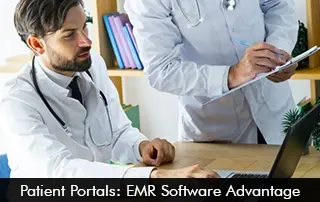
EMR Software has more to do than just digitize patient records; it goes beyond by offering users patient engagement solutions such as Patient Portal. The patient portal platform in the EHR System is an online health tool that enables patients to stay empowered. They can participate actively, from scheduling appointments, viewing lab results, paying bills, to having direct contact with their provider.
Patient Portal EMR Software Usages for Patients
Patients can easily log in to their Patient Portal EMR Software and do the following tasks in a breeze from the comfort of their homes:
- Schedule non-urgent appointments
- Refill prescriptions
- Request referrals
- Make online bill payments
- View lab results
- Complete forms
- Message care teams via a HIPAA-compliant two-way messaging platform
- Update contact or insurance information
- View medical history
- Have access to educational materials and resources.
Value of Patient Portal Platform
A modern Electronic Medical Records (EMR) Software offers features and functionalities that can help drive patient engagement. This enables them to stay satisfied and have a positive impact on their health outcomes. Certain tools, like automatic appointment reminders, ensure that patients show up for appointments and help simplify the patient intake process by allowing patients to fill out online intake forms.
Recent HINTS Surveys reflect that patient portal adoption rates are increasing as patients have expressed that they can help manage their health conditions, and keep them satisfied.
Furthermore, patient portals expedite administrative procedures, relieving the workload of medical personnel, enhancing operational effectiveness, and ultimately leading to financial savings.
Integrated Patient Portals and Standalone Patient Portal EHR Software
Integrated patient portals are a component of an Electronic Health Records Software system that provides real-time patient data access, quicker communication with healthcare professionals, and a comprehensive view of a patient’s medical history. Included in many top EMR Systems vendors, such as athenahealth EMR Software, Epic Systems, and AdvancedMD EHR Software.
Standalone patient portals, on the other hand, are distinct systems that are not directly connected to EMR Software, giving patients some independence but potentially causing delays in data access and limiting communication.
Benefits of Integrated Patient Portals
Patient Portals in EMR Software are integrated solutions and can benefit healthcare organizations by:
- Seamless integration with software systems such as electronic health records software and practice management systems.
- Provides quick, real-time access to medical records and health information.
- Facilitates secure and streamlined communication between patients and clinicians.
- Supports care coordination.
- Improved administrative workflows as there is smooth coordination of scheduling, patient billing, and prescription management.
New Capabilities in Patient Portal EMR Software
New AI features in EHR Software are integrating conversational AI, revolutionizing real-time patient communications. The Oracle Health EMR System leverages Artificial Intelligence, making medical data easier to understand for patients. They can easily ask about what lab values mean and reduce any confusion, giving better direction to patients.
Academic research reflects that using AI-propelled chatbots can boost patient portal usage, improve medication adherence, and alleviate the issue of appointment no-shows. These innovations are making Electronic Medical Records (EMR) Software make patient engagement solutions intelligent and interactive.