
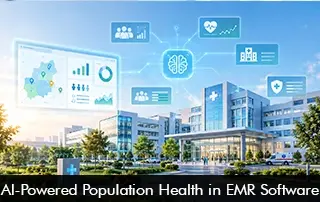
There is a wealth of information available to healthcare providers. But the real challenge is knowing what providers can do with this massive amount of data. This is where AI-powered population health in EMR software shines brightly. AI has made life easier; it analyzes information across different patient populations. With AI-powered population health tools in EHR systems, healthcare organizations can identify gaps in care, detect high-risk patients, and efficiently monitor quality measures. This allows care teams to focus on issues that need more attention to enhance overall population health and patient outcomes.
Why Does AI-powered Population Health in EHR Software Matter?
In the United States, hospitals are now more focused on improving health outcomes while managing costs. This has become even more important as value-based care models have replaced the traditional fee-for-service model.
The robust population health features in electronic medical records software can answer practical questions about high-risk patients and care gaps across populations. AI steps in proactively to analyze this vast data so providers can use it in meaningful ways. When the most relevant information is brought to the surface, care teams can act quickly. With AI tools, patients can be prioritized for outreach by researching hundreds of records.
Which EMR Software Vendors offer AI-Powered Population Health Tools?
Prominent cloud-based software vendor athenaOne EMR software is bringing AI into population health and value-based care. The AI-native capabilities in the athenaOne platform can empower care teams like never before. With AI integrations, care gaps can be identified, patient populations can be stratified, and quality measures can be monitored over time. There are also analytics and reporting functionalities that can help healthcare organizations identify opportunities and hence capitalize on them.
The second EHR software vendor that has prioritized AI tools for population health is Oracle EMR software. The population health solution uses AI in highly practical ways. Patient needs can be easily identified, and readmission risks can also be assessed. Oracle Health software has introduced its population AI assistant. The assistant can summarize care gaps and provide valuable insights from a patient’s records. These important details can enable providers to make informed clinical decisions at the point of care.
How Can This Make a Difference in Healthcare?
The biggest revolution is that this isn’t an additional add-on feature available in EMR software. The use of AI is expanding, helping care teams to utilize vast amounts of patient data. AI tools work in practice to support outreach and monitor population-level outcomes. Moreover, AI in EHR systems can support value-based goals and even reduce avoidable healthcare costs.
For patients, this is great news, as they are reminded of follow-up care, and any worsening chronic conditions can be managed by timely intervention. Technology and provider judgment both play a vital role in enhancing care quality. AI acts as a real-time assistant, making data available to care teams and spotting patterns in patients that need more attention. This can ultimately make populations healthier.